

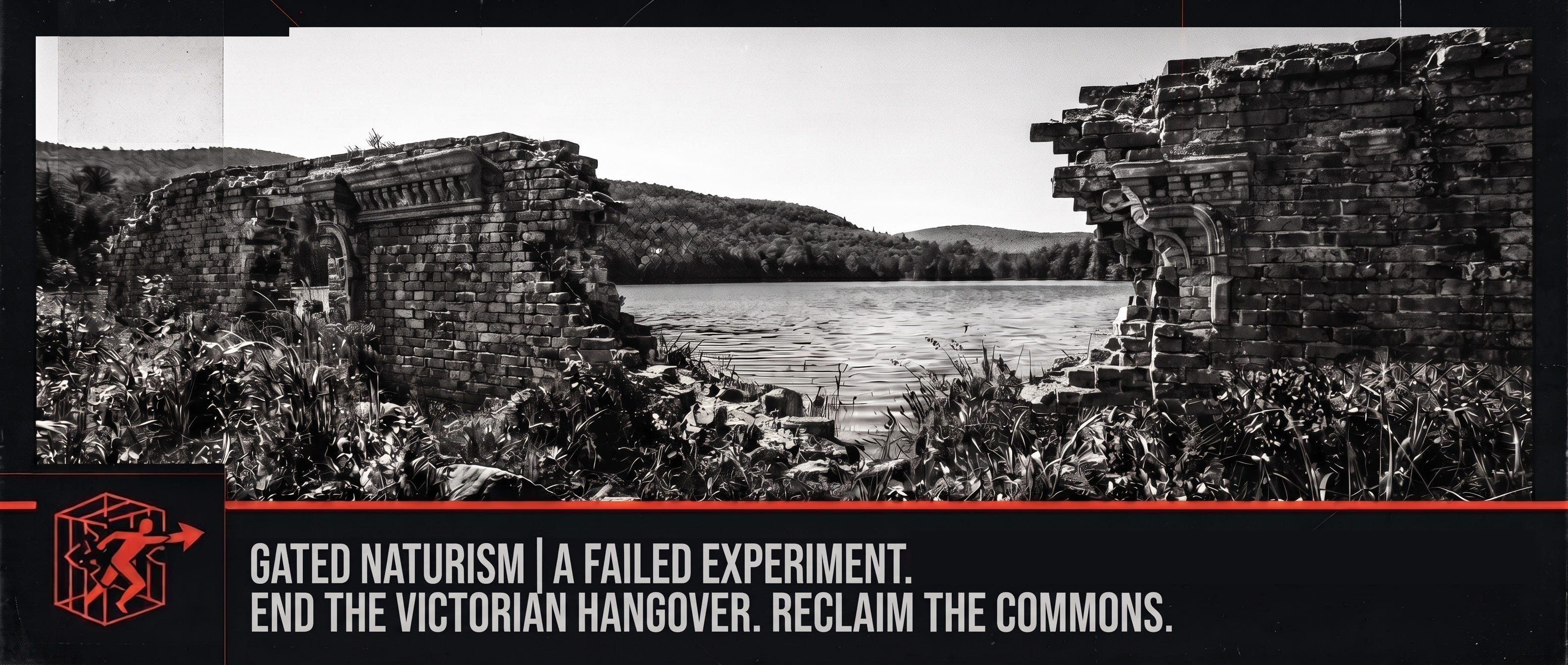
I am mad, and for good reason. We have spent over a century playing the most elaborate, self-defeating game of political hide-and-seek in human history in response to the Victorian Era, puritanical prudishness, and class structure hangovers.
Let us dispense with the polite fictions, the gentle academic hand-wringing, and the comforting myths of the gated resort. Let us state the plain, unvarnished truth: Isolating nudity to sex, plus isolated beaches and resorts has been an unmitigated, catastrophic failure.
It should never have happened. Now I understand that in response to Victorianism and Puritanism there was very little choice. But enough is enough.
Why? Because the moment you build a fence around a beach, buy a membership card, and designate a fenced-off resort as the only place where human beings are permitted to look like human beings, you haven’t liberated anything. You have built a cage. You have created a containment zone, reinforcing to the rest of the world that the natural, unremarkable human body is a dangerous, illicit novelty that must be locked behind an administrative checkpoint.
The Personal Cost of Silence: A Confession
For years, if you asked me why I cared so deeply about body comfort, about the freedom of the unburdened human form, and why I fought against the suffocating weight of the Victorian hangover, I would have pointed straight to a moment in my youth. At twelve years old, I stumbled across old 1930’s nudist publications in a university library—publications that possessed a rare, grounded philosophy that the body was good, natural, and nothing to be ashamed of. That encounter brought me a tremendous, life-altering wave of healing. It taught me that my body was not a crime scene.
For a long time, that healing became my singular focus. As someone who is primarily asexual or demisexual—whether shaped by genetics, the complex echoes of abuse, or factors I may never fully untangle—I have always found myself far more comfortable talking about body comfort, anatomical neutrality, and nudity than about sexuality itself. Navigating sexual issues has never been my natural terrain or my primary vocabulary.
And for most of those years, I actively avoided the subject of child sexual abuse. That was the raw, unhealed wound underneath it all—because at the age of eight, I was sexually abused by peers, by neighbors.
My deepest, most urgent passion in this life is trying to prevent as much child sexual abuse as possible, so that other children never have to endure what I went through. But as I’ve started to open up more fully about that survival, a hard, humbling realization has settled in.
While bodily comfort is essential, it is far from enough.
Simply teaching people to be comfortable with nudity will not automatically stop abuse. The puzzle is much larger, and the work is much harder. Protecting our children requires moving past our own personal hesitations or a narrow focus on physical exposure; it demands absolute, uncompromising transparency. It means teaching children the correct, anatomical terms for their bodies from their earliest days, fostering open communication where no topic is locked behind a wall of taboo, and ensuring that secrecy—the absolute oxygen of the abuser—is starved of its fuel.
Body comfort is a vital pillar, but it is only one piece of a much larger architectural shift. We cannot hide behind naturism as a magic wand. We have to look the dark realities of abuse square in the eye, dismantle the silence that protects perpetrators, and give our children the language, the boundaries, and the unshakeable dignity to speak out.
The Absurdity of the Gated Sanctuary
For decades, well-meaning people retreated to the fringes. They bought acreage in the woods, erected high privacy hedges, and sealed themselves off behind iron gates. They whispered among themselves about “body freedom” while driving two hours out of town just to take off their clothes in private—as if the human skin were something illegal that required a speakeasy.
And what was the result of this grand separatist experiment? Society at large learned nothing.
The puritanical machinery of our culture didn’t look at a secluded naturist resort and think, “Ah, look at those enlightened souls; we should reconsider our relationship with anatomy.” No. They looked at it and thought, “Good. Keep the freaks in the pen. Keep the nakedness over there, far away from ordinary life, where it belongs.”
By accepting a lifestyle ghetto, organized naturism absolved the rest of the world from ever growing up. It allowed the Victorian hangover to fester unchecked in our schools, our streets, our media, and our laws. It transformed a birthright into a boutique hobby. It traded the universal liberation of the human form for a weekend pass in a fenced-off paddock.
The Legal Panopticon: Indecency Laws and the Registry
Look at how our legal code enforces this sickness. We live under statutes where simple, harmless, unadorned human anatomy is classified as a felony crime of “indecency.” There is not a shred of empirical or legal evidence showing that a human being witnessing ordinary anatomy in a non-sexual context causes actual harm to anyone. Yet our legal system treats the unclad human form as equivalent to violent assault, slapping ordinary people with lifelong sex offender registrations for the crime of existing in the sunshine without a scrap of fabric.
This is not law enforcement; it is state-sanctioned terrorism. By accepting that public space belongs exclusively to textiles, we have allowed lawmakers to criminalize our biological reality. We have created a legal system that treats a person’s natural, unclad form as a predatory menace, while actual, destructive harm goes under-prosecuted because our cultural alarms are permanently short-circuited by puritanical hysteria.
The Media’s Potted Ferns and L-Shaped Sheets
And where does this mass psychosis get reinforced daily? In the media we consume.
Look at how television and cinema treat the human body. Writers and directors are forced to bend over backward—literally—staging scenes with absurd, physics-defying L-shaped bedsheets pulled up to the collarbone, or awkwardly framing actors behind conveniently placed potted ferns, kitchen counters, and steaming coffee mugs. Every visual trope screams a singular message: The human body is an emergency.
The hypocrisy of this conditioning was vividly illustrated in an episode of Boston Legal (Season 3, Episode 1, “Can’t We All Get a Lung?”), featuring a therapeutic scene where a sex surrogate works with Jerry Espenson, a client struggling with deep-seated intimacy and body anxiety. As part of the therapy, after removing her robe, the surrogate stands fully unclad before him and gently prompts, “Could you look at me, Jerry? See? There’s nothing terribly foreign about the female body, Jerry.” It is a moment designed to teach clinical, unbothered acceptance of ordinary anatomy. Yet how did the camera handle it? Like her nude body was the plague. The lens twisted itself into knots, utilizing every trick in the book—over-the-shoulder angles, strategic framing below bed covers, and tight close-ups—to ensure the audience never actually saw her body. We were shown the patient supposed to be viewing her, for therapy, for healing, but the camera completely averted its gaze. It sent a glaringly contradictory message to the viewers at home: even within the clinical, compassionate context of psychological healing, the unadorned human form is still deemed too illicit, too dangerous, and too taboo for the Prime Time TV screen that has no issues with extreme violence.
The cultural tone of our media treats anatomy as inherently scandalous, titillating, or vulgar. It reinforces a relentless anxiety that if skin is visible outside of a designated commercialized context (like a locker room, or an “adult” platform), the fabric of civilization is about to tear. We have been conditioned to panic at our own reflection.
The True Radicalism of Normalcy
The human body is not a lifestyle choice. It is not a hobby. It is not an alternative recreation to be filed away next to pickleball and birdwatching. It is the basic, fundamental baseline of human existence.
Shame should have been eradicated decades ago. We should not be debating whether humans have a right to exist unburdened by unnecessary textiles in a designated zone; we should be fighting against the grotesque, manufactured pathology that treats the ordinary human form as an obscenity.
When you segregate normalcy, you validate repression. When you make naturalness a subculture, you ensure that the dominant culture remains toxic, fearful, and perpetually titillated by its own clothing.
Look closely at the machinery of modern anxiety. We have engineered a society so paralyzed by the sight of its own skin that we have turned biological reality into a crime scene. We whisper about anatomy as if it were contraband, cloak our children in diagnostic ignorance, and treat the human form like an explosive device waiting to detonate.
And what is the bill for this collective neurosis? We tally it in blood, in silence, and in systemic failure.
The Medical Price of Modesty
Consider the examination room. We have created a culture where patients—particularly women, adolescents, and older adults—feel such profound, internalized embarrassment about their own bodies that they actively withhold symptoms. They delay vital skin checks, ignore suspicious lumps, and skip preventative screenings because the mere thought of undressing before a clinician triggers a paralyzing wave of shame.
When a society teaches its citizens from infancy that their anatomy is inherently illicit, exposure becomes a humiliation. Is it any wonder that millions avoid preventative care until a treatable condition metastasizes into a catastrophe? We have sacrificed human lives on the altar of puritanical propriety, trading early detection for the comforting illusion of modesty.
The Mental Health Toll of Enforced Disconnect
And what of the mind? When nature is criminalized, the psyche fractures. We raise generations taught to view their physical selves with suspicion, disgust, or hyper-vigilant self-criticism. Every curve, mark, and muscle is measured against an impossible, sanitized corporate standard, while the natural, unadorned reality of human life is scrubbed from public view.
This enforced alienation breeds a staggering epidemic of body dysmorphia, anxiety, and social isolation. We have convinced people that their natural state is offensive, driving them inward, breeding shame, and severing the primal, grounding connection between mind and physical reality. We are starving people of the most basic, restorative truth of existence: that they already belong in the skin they occupy.
The Public Safety Paradox
Look at public safety and crisis response. In moments of mass emergency—chemical contamination, water accidents, or sudden environmental disasters—seconds count. Yet we inhabit a culture so prudish and brittle that our emergency protocols are hamstrung by clothing dependencies, and our public spaces are governed by laws that treat the naked human form as a public nuisance rather than an anatomical fact.
When we cannot look at a human body without sexualizing it, pathologizing it, or panicking over it, we lose our collective sanity. We become incapable of clear-eyed assessment, vulnerable to manipulation, and paralyzed by a fear of our own reflection.
Reintegrating the Body: How We Normalize Ordinary Anatomy
If retreating to a gated compound is a dead end in the long run, how do we actually weave bodily normalcy back into the fabric of daily life?
First, we must be fair to the present reality: organized naturist clubs, private pools, resorts, and dedicated beaches do still serve a vital, protective purpose right now. Until society at large outgrows its puritanical panic, these spaces act as essential sanctuaries. They provide a safe harbor where people can experience a temporary reprieve from legal threats and cultural hostility, discovering that their bodies are nothing to be ashamed of. They are valid stepping stones and breathing spaces. The danger only arises when we mistake the stepping stone for the destination—when we accept the gated club as a permanent containment zone instead of a temporary staging ground for broader cultural change.
At the same time, we start by acknowledging a basic, practical boundary. Clothing is undeniably functional for labor, protection, and navigating the friction of working and public life. We wear garments to shield ourselves from the elements, to carry tools, and to move through public commerce. That is utility, not morality.
The pathology begins when we insist that textiles are a moral prerequisite for human existence everywhere, all the time.
In restful, restorative, and recreational spaces, clothing is not only unnecessary—it is an absurd hindrance. We just shouldn’t have to join clubs or travel hours to enjoy that, it should be a part of normal daily life. Consider sleep: medical professionals routinely recommend sleeping unburdened by restrictive garments to allow the skin to breathe, regulate core temperature, and support restorative rest. Yet millions live in such acute bodily alienation that even the privacy of their own beds is policed by pajamas.
Then look at recreation, most obviously water. Throughout human history, long before the Victorian obsession with sewing artificial constraints onto our skin, water was where the body was simply the body. Think of a backyard pool, a secluded freshwater pond, a lake shore, or an ocean beach. Swimming and water immersion are inherently incompatible with wet, clinging textiles—fabric in water is a logistical nuisance, an unnecessary drag, and a friction-laden absurdity. A swimming pool or a natural shoreline should be the ultimate zone of anatomical neutrality, where water meets you as you are, stripping away socioeconomic posturing and designer body shaming.
Normalizing the body means quietly expanding that same unbothered neutrality into our private home sanctuaries, our family life where children grow up seeing unadorned anatomy without a whisper of taboo, and quiet retreat spaces. It is about shifting our cultural muscle memory away from theatrical concealment and toward quiet, everyday presence. When we reserve clothing for where it actually serves a functional purpose, and reclaim our rest, our sleep, and our recreation for the skin we were born with, the obsession with artificial modesty simply dissolves.
After a long day of work many people kick off their shoes and shed some restrictive clothing as soon as they get home, what about shedding all of it?
The Danger to Our Children
Look especially at the architecture of the trap we have built for our children. We live in a culture where 1 in 4 girls and 1 in 13 boys in the U.S. are estimated to experience child sexual abuse; this is unconscionable.
Yet we teach children from their earliest days that parts of their skin is a secret, an illicit liability, a private territory wrapped in taboo. Something that we are uncomfortable with, so they become uncomfortable too. We shroud them in enforced ignorance, whispering about anatomy as if it were contraband. And then, with staggering hypocrisy, we act bewildered when predators exploit that exact vulnerability.
When a child is raised in a culture of body shame—where normal anatomy is treated as shameful, hidden, and unspeakable—the mechanics of grooming become terrifyingly easy. Secrecy is the predator’s oxygen. By teaching children that their own bodies are sources of embarrassment and discomfort, we hand abusers the ultimate weapon: silence. A child who believes their anatomy is inherently improper is far less likely to report boundary-crossings, because the shame of disclosure feels heavier than the abuse itself.
Enforced anatomical ignorance does not protect children; it disarms them. It ensures they lack the vocabulary, the bodily autonomy, and the unclouded self-worth to cry out when lines are crossed. Body comfort alone is not enough—we must match physical ease with radical transparency, proper anatomical education, and open, unshakeable communication.
The Digital Panopticon: How Deepfakes Weaponize Shame
And if childhood is where the vulnerability is manufactured, the digital age is where it is industrialized.
Look at the modern scourge of non-consensual deepfakes and digital undressing. Why do these violations destroy lives, shatter careers, and drive victims into profound psychological trauma? Because we live in a society wired for puritanical terror.
Deepfakes weaponize our collective neurosis. They operate entirely on the premise that the human body is an obscenity—that having your unadorned form exposed, real or fabricated, is an unmitigated catastrophe. The extortionist, the bully, and the purveyor of algorithmic exploitation rely entirely on that manufactured terror to extort, silence, and humiliate.
Consider the antidote: a culture of radical bodily normalcy and open truth. If a society viewed the whole human form with the same casual, unbothered neutrality as a hand or a forearm, the entire economic and psychological engine of digital blackmail would collapse overnight. If we were fundamentally comfortable with our bodies, there would be no shock value. There would be no secret to expose. There would be nothing left to traumatize.
End the Stigma: A Call to Action
We do not need another “nudist” club. We do not need another secluded beach, another membership fee, or another weekend reservation behind high privacy hedges.
Every time we pack our bags to drive hours out of town just to take off our clothes in private, we validate the prison warden. We tell the world that natural human skin belongs only in a quarantine zone.
It is time to stop hiding. It is time to dismantle the Victorian hangover where it lives—in our laws, in our schools, in our media, and in our own exhausted habits. Bodily sovereignty is not a boutique hobby; it is our birthright.
We are done asking for permission to exist in the skin we were born with. Join us as we tear down the walls of the reservation, challenge the legal terrorism of indecency statutes, and demand a culture where the human body is ordinary, unburdened, protected, and free.